
Masters of Existence
Subjectivism and Self Worship in Satanism
https://www.dpjs.co.uk/worship.html
By Vexen Crabtree 2015
1. Creating Gods According to Need
“Man has always created his gods, rather than his gods creating him.”
Book of Lucifer 1:1
"The Satanic Bible"
Anton LaVey (1969)1
People create gods in their own image according to their own desires and needs. Gods tend to agree precisely with the beliefs of their believers, care about the same things as those who believe in them, even to speak to them personally, to be a friend to the lonely. They fulfill the needs of some people so neatly because it is those people who themselves create the personalities and wishes of the God they profess. It is Human imagination at work, tied in with the ego, and with the subconscious. Gods are our creations. Within organized religion, people's opinion on their "god" is always individual and subjective even though they as a group call their God by the same name. Depending on a person's will and need they search out gods that closely match what they themselves want.
Satanism abhors these gods in their multitudes. Satan is the anti-god... destroying all these invented external sources of power. In the name of Satan, there is only one true power that exists above Gods: Human minds. For it is only Human Beings that have made gods, and it is in our image that they are made. We create gods: We give them Human emotions, human desires, and even give them hands, faces, bodies, clothes and weapons. Why is all this so? We are dishonest. We create gods in this manner because we dare not admit the truth: We Are Gods.
All of our reality is constructed in our own heads. All our morals are our own interpretations. Our life is ours, and no-one else's. If anything can be called a Creator, then it is ourselves. A god with no believers doesn't exist. Only we have the power to imagine-up gods! These divine beings are at our mercy; they are weak, we are strong. When we realize just who holds the balance of power, we will realize that all external gods are false, only the internal one is real. It is our own sense of ego that we feel from god. It is our own pride that makes us think we know the truth. God is the individual, and each individual may as well be his own god.
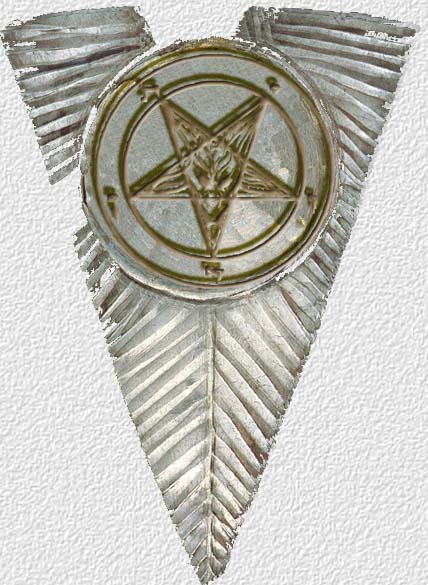
The first and second chapter of the Book of Lucifer in The Satanic Bible1 expands on this idea greatly. Epistemologically, God is only ever a reflection of the self. This state of affairs is represented by Satan, as a symbol of the prideful ego, rather than of God. God is a symbol of homocentricity and all of its errors, to accept Satan instead of God is to accept the self, and to be truly honest about the subjective state of reality that we all live in.
2. An Idol Worthy of Worship
Sometimes in place of a god in a person's heart, if they cannot accept themselves, is some other ideal or symbol that drives them. They pretend to themselves that their plans, ideas, motivations and desires come from this object of pseudo-worship. For some people, this object is not a religious icon, but a secular one such as a football team, a political ideal, human rights, a class war or a nation. From that source they externalize their own compulsion. They have to fight that fight, for the greater good! That way, they themselves are not to blame. They're just an agent of the greater good. Satanists know that this is a lie. The true source of the person's strong willpower is not in the ideal that they strife for, but it is themselves. Their own ego, their own pride. Activists and pacifists, Satanists and religionists, evangelicals and skeptics: they're in it for themselves. Don't let them convince you otherwise! Let us cut away the bloated self-delusions and accept that actually, the self is the most suitable object of worship, for the self, the ego, the individual, is the source of all behaviour and thoughts both good and evil, and therefore represents the totality of our experience of life.
“I worship truth. I worship reality. The best symbol of reality is Satan. In order to be true to my beliefs, I must seek out the truth, to know. In Satanism, the self is God. Out of the self comes one's own experience of life. This experience of life is sacred. A Satanist does not pollute this life with skewed perceptions of reality. To have a skewed perspective on reality is, for a Satanist, to worship a falsehood. Satanism is the worshipping of truth and reality, and the abolishing of falsehood, deceit and lies. Self-deceit includes wishful thinking, ideas of afterlives and reincarnation, the idea that an eternal universal creator cares about us, the idea that we are greater than we are. There is no 'good and evil', just subjective Human judgements. The Third Satanic Statement does not lack clarity:
3. Satan represents undefiled wisdom, instead of hypocritical self-deceit!
”"Satanism: The Worship of Truth: 1. Undefiled Wisdom" by Vexen Crabtree (2005)
Compare the healthy approach of the Satanist with the desperate constructs of the theist, as criticized by Robert Green Ingersoll:
“An honest God is the Noblest Work of Man.
EACH nation has created a god, and the god has always resembled his creators. He hated and loved what they hated and loved, and he was invariably found on the side of those in power. Each god was intensely patriotic, and detested all nations but his own. All these gods demanded praise, flattery, and worship. Most of them were pleased with sacrifice, and the smell of innocent blood has ever been considered a divine perfume. All these gods have insisted upon having a vast number of priests, and the priests have always insisted upon being supported by the people, and the principal business of these priests has been to boast about their god.”
"Gods" by Robert Green Ingersoll (1872)
3. Self Worship
All things good and evil are good, or evil, because I say they are. I do not have an objective view of things, or people, so immoral and moral are what I have been taught they are, or what I subjectively think they are. Even if I believed in an objective definition of "good" or "bad" then it would still only be my belief, not a fact, and certainly not objective.
“There is nothing either good or bad but thinking makes it so.”
Shakespeare
“Enemy, ye shall say, but not villain; Diseased one, ye shall say, but not Rogue; Fool, ye shall say, but not Sinner.”
"Thus Spake Zarathustra" by Friedrich Nietzsche (1885)2
Who can take self worship seriously? What does one do in order to do such a thing - what does it mean, anyway? It is a word that can apply to both the sacred and the profane:
wor-ship (wûr'shìp) n.
1. a. Reverent love and devotion for a deity or sacred object.
1. b. The ceremonies or prayer by which this love is expressed.
2. Ardent devotion; adoration; his worship of fame.
What is divine in the world that I can claim to worship?
- What is sacred? My life is sacred.
- What is worshipped? The reality I observe is worshipped, as it is my creation.
- Who is God? I am god.
- Who are you? I am a product of biochemistry.
- What created you, then? Large scale physics created me.
- Are you alive? I define life to include myself, yes.
If I prayed, I would not be externalizing or relying on hope. A prayer for me is a meditation and a reflection: "can I do it?" rather than "will it get done?". If I want something done it is up to me to make it happen. Every prayer to an external creator is a waste of time during which I could be achieving that which I would otherwise only have prayed for. A Satanist does not pray for money - he tones his own skills and gets a job instead.
Try:
Self Worship means that you consider your world to be the construct of your own. The perusal of the truth, the rational truth, is the holy mission of those who worship themselves. No assumption should be left to fester, and no taboo should be left untouched. A mistruth within our personal models of reality is blasphemy to our existence. Keep your reality pure, keep it true, do not let refutations trouble you - adapt your beliefs to match the evidence and move on. Don't hold on to beliefs out of counterproductive pride.
Religion and worship must be honest. If you are going to put your heart, desires and motivations behind an object of devotion, there is no point lying to yourself about the nature of your psychological projections. The source of this objectification of your ideas about reality is your own mind. The abstract nature of god, however convoluted, is your own creation. That's why all the gods of history have had human emotions, cared for humans in particular, put the Earth at the center of their schemes, cared about what us human wear, think, do and feel. Gods have even looked like us. Let us discard such wishful thinking and admit that we're making it all up. In Satanism, we do not worship others or ideas. We worship ourselves, as we are the source of all the great things we adore. Self-worship is the most honest form of religiosity.
“To the Satanist, he is his own God. Satan is a symbol of Man living as his prideful, carnal nature dictates. [...] Satan is not a conscious entity to be worshipped, rather it is a name for the reservoir of power inside each human to be tapped at will.”
"The Satanic Scriptures" by Peter Gilmore (2007)3
- Most of this approach to truth falls under the same umbrella as do scientific and skeptical methods. See "What is Science and the Scientific Method?" by Vexen Crabtree (2014) and The Human Truth Foundation.